Firsts of July always strike me as offering an opportunity for planning, for reflection, for projection and preparation. The first of each month offers the same, of course, in smaller scale, as does the first of each week.
But the First of July provides larger perspective, extending both ways. We are mid-way through the year, and, depending upon our nature (both in general and at the moment) we may ask:
Is this year half-over, or only half-begun?
The answer differs from year to year, but more often than not, the older I get, I choose the latter,
I've had easier years than this one, but this one's only half-started.
Plenty of 2015 tomorrows ahead, after all.
Half a year's worth.
Wednesday, July 01, 2015


Monday, December 16, 2013
Some Thoughts on the Occasion of Arthur C. Clarke's Birthday
Today would have been Arthur C. Clarke's 96th birthday, not that the
calendar or any other excuse is needed to celebrate his life and achievements.
In the five-and-a-half years since he died, Clarke's achievements
seem to me only to have grown. Looking
back now, four years shy of his centenary. I'm beginning to get a real sense of
just how large that achievement is. And this after a lifetime of reading him
(and even knowing him, a little, during the years I edited OMNI). Not many writers'
accomplishments actually seem to enlarge after their death. Arthur Clarke's do,
at least to me.

I think I was eight or nine the first time I read one of his
novels --A Fall of Moondust in a Reader's Digest Condensed Books version. (I think that was the one and only time
pure SF was tried by the company.)
It didn't take long for me to seek out -- and, happily, find -- more by him. In pretty quick order I worked my way through the first round of classic Clarke:
Earthlight
The City and the Stars
The Deep Range
and, best of all for me, and best of all of his books:
Childhood's End.
By the time I was eleven or twelve, I had made my way
through these -- and through Childhood's End more than once -- as
well as most of his short stories.
On the horizon even then, and gradually rising above it as I entered adolescence was Clarke's collaboration with Stanley Kubrick, which was released in the summer of 1968.
2001: A Space Odyssey
remains, to my tastes (nor do I think I am alone) the finest science fiction
film ever made, and one of the dozen or so finest films of any sort, it also
served as a calling card introducing Clarke to an even larger audience than he
already enjoyed. One grew accustomed to seeing him interviewed on television;
he was a constant sage presence a year later during coverage of the first moon
landing.
Other SF writers would make a large cultural impact -- Isaac
Asimov and Robert Heinlein, to name the other two of the "Big Three"
as they are still known; Frank Herbert with the phenomenal success of Dune; Ray Bradbury for being, well, Ray Bradbury;
Philip K. Dick posthumously and mostly through movies that misrepresent his
books and vision.
But it was Arthur C. Clarke who broke through to the large
mainstream media audience first, and remained through the rest of his long life
a wise, bemused, funny, and insightful ambassador for SF, as well as for the enlightened
use of technology to help rescue the world and its peoples from the
situation(s) it found itself in and still does.
Weapons and weapons systems and warfare were definitely not among Arthur's visions enlightened
applications of science, in the world or on the page. The best science fiction
film of all time doesn't have a single gun in it. Nor do his novels contain the
vast space battles that still afflict far too much print SF and virtually all
filmed SF. Of his novels only Earthlight
contains a space battle and, considering its author, you can be assured
that it remains one of the best such battles ever set down.
After 2001 and Apollo, Clarke could have rested on his
laurels -- his achievement was already immense -- and on the income produced by
his speaking engagements, royalties, and the nonfiction that flowed steadily
and always provocatively from his typewriter. But then he wouldn't have been
Arthur C. Clarke.
Through the Seventies and beyond , more novels, ambitious ones, appeared:
Rendezvous With Rama
(many people's choice for his second best novel)
Imperial Earth
The Fountains of
Paradise (my choice for his
second best novel)
The Songs of Distant
Earth
Not to mention the other volumes in what became the Odyssey
Quartet -- 2010, 2061, 3001, as well as several smaller novels that lacked the
ambition of his major works but carried the distinctive Clarke touch admirably.He remained a working writer through the last three decades of the Twentieth Century.
I leave aside the fact that over the last couple of decades
of his life Clarke participated (that, I think, is the right word) in the creation
of quite a few books with collaborators whose appearance did little to enhance
his reputation. The best of these -- his collaborations with Stephen Baxter --
are honorable explorations of his ideas and themes, as was his final novel, The Last Theorem, written with Fred Pohl (that "with" is tricky: Fred
did virtually all of the writing on this one, as I understand it). Theorem turned out to be not a
particularly good example of either Clarke or Pohl, but it wasn't as bad as
many thought. The collaborations with Baxter are, in their own way, excellent.
Of the other collaborations, licensings of his name,
participation (there I go again) in television explorations of unexplained phenomena,
and etc., not much to say. Most of these ventures have already faded or
disappeared; most of Arthur's best books, fiction and nonfiction, continue to shine brightly.
Thinking about it, about him, about all he produced in
fiction and nonfiction, all of the help he extended to his adopted Sri Lanka
(and by extension to the rest of the emerging nations of our world), not to
mention his genuine contribution to science and global communications -- not
for nothing are the orbits our comsats, as they used be called, known as Clarke Orbits -- and all of the speeches
and television appearances, I find myself actually amazed that he was only in
his early 90s when he died. That much accomplishment in nine short decades? How is that possible?
Actually, it's pretty easy -- if you're Arthur C. Clarke.
Which he was.
And still is and, I believe, will remain to be.
Happy Birthday, Arthur -- nice to know that in so many ways you're still here.
Monday, September 02, 2013
PAT CADIGAN, HUGO WNNER!
Almost as thrilling as the news that Pat Cadigan has
just won the Hugo Award for her novelette "The Girl-Thing Who Went Out forSushi" from the anthology Edge of Infinity, is the realization that this is Pat's first Hugo. Well-deserved,
and damned well-earned!
As hard to believe as that is, it's equally hard for me to
believe that her career now extends more than
a third of a century , back to
her first stories in fan publications. Her career, like most writers' careers,
has had its ups and downs, but the trajectory of that career -- always a
different thing from the temporal reality of any writer's career -- has
remained in the ascendant.

That she was -- and is -- a writer of large ambition has
been clear from the moment, in the early '80s when her "Deadpan
Allie" stories began to appear, although it was probably her
"Pretty Boy Crossover" that really began her breakout from new writer
to major writer.
The Allie stories formed the kernel of her first novel, Mindplayers (1987), with its killer
opening:
I did it on a dare. The type of thing where you know it's a mistake but you do it anyway because it seems to be Mistake Time.
No mistaking that voice
and what it had to say -- there was a writer
in the room.
It was around this time too, maybe slightly before, that she
became known as the "Queen of Cyberpunk." That she was, but so much
more as well. Just how much more would begin to made clear as her second and third novels appeared, a year apart, in the early '90s.

That second novel, Synners (1991) pushed cyberpunk -- and then some -- in half a dozen simultaneous and simultaneously different directions, a huge leap in both craft and art over Mindplayers, and a major novel by any standards, not just those of cyberpunk.There was not a more complex, or more complexly provocative SF novel in the 1990s. It is the richest of her novels so far.
Her third, Fools (1992), pushed matters of identity (real and virtual) even further. Though smaller in scope and girth than Synners, Fools marked another advance in Pat Cadigan's craft, not to mention her art, and may be the best of her books (ditto "so far"), although Synners may still have the edge for me in the sheer size of the ambition that powers its narrative..

Friday, May 03, 2013
Window on the World
There comes a moment at my desk every year when I glance out the window to my right and see that the trees' progression toward spring is complete.
 This year's progress was slow, even fitful, and for a time I wondered -- as I have before, probably most years -- if some of the older limbs would bear leaves again.
Some of them haven't this year, and may not last through the next heavy storm.. But the ones I have been most concerned about appear to be doing fine.
I love the view during all seasons.
And during all seasons, today's season most definitely included, it is a view that calls for me to step away from the desk, to get outside, to take a closer look at the world the trees live in, and be reminded, as always anew, of the ways in which that world informs and expands whatever world or worlds I am engaged with at this desk.
.
 This year's progress was slow, even fitful, and for a time I wondered -- as I have before, probably most years -- if some of the older limbs would bear leaves again.
Some of them haven't this year, and may not last through the next heavy storm.. But the ones I have been most concerned about appear to be doing fine.
I love the view during all seasons.
And during all seasons, today's season most definitely included, it is a view that calls for me to step away from the desk, to get outside, to take a closer look at the world the trees live in, and be reminded, as always anew, of the ways in which that world informs and expands whatever world or worlds I am engaged with at this desk.
.
Tuesday, January 01, 2013
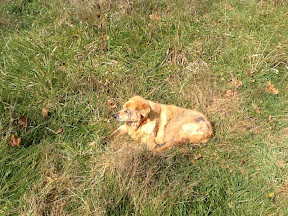
IVY 1998 - 2012
Facing the new year without our Ivy, who passed away peacefully two weeks ago. There is a great, loving empty space that this good dog filled for so long.
I can see her there, and feel her there, and I am sure that I will always be able to.
She is at rest now, next to Holly, on this land that was, from the time she was six weeks old, the only home she ever knew.
And how wonderfully she graced it.
Goodbye, little Ivy. Goodbye, our good girl.
I can see her there, and feel her there, and I am sure that I will always be able to.
She is at rest now, next to Holly, on this land that was, from the time she was six weeks old, the only home she ever knew.
And how wonderfully she graced it.
Goodbye, little Ivy. Goodbye, our good girl.
Thursday, October 04, 2012
Brian Aldiss Reflects Upon Russian Literature, Leading Me To Reflect Upon Aldiss
Brian Aldiss briefly (to say the least) on classic Russian novels in today's Telegraph.
Yet in even in the three paragraphs the Telegraph allowed for his comment, Aldiss manages to remind us of several Russian classics we've meant to read or re-read, and to refer us to one that may be unfamiliar.
His comments on Dostoesvsky, Gogol. Tolstoy pack much resonance into few words, and will have me revisiting both House of the Dead and Resurrection in the near future (the Tolstoy probably nearer than the Dostoevsky).
But it is the author Aldiss leads with, Marie Bashkirtseff, who will be the the large discovery for many readers. Aldiss writes of the powerful effect of Bashkirtseff's diary on him at 14 -- an effect that has lasted for nearly 75 years!
Marie Bashkirtseff died at 25 after a remarkably productive decade of writing and painting. At 87, Brian Aldiss is still vigorously producing novels, stories, essays, poems, paintings.
I realize now that I was around 14 when I first encountered Aldiss's work, and have myself remained enthralled with this elegant, energetic, intellectually and stylistically adventurous and audacious writer ever since. While that's far less than 75 years, it's somehow closer to 50 than to 40, a reminder of the ruthless accuracy of the title of Aldiss's superb autobiography, The Twinkling of an Eye.
There is nearly always some Aldiss reading or re-reading going on at this desk or in my reading chair. He is an imminently re-readable author, always offering new levels to discover when one brings new perspectives (if only those of time passed) to familiar pages.
And through those pages Aldiss has always been generous in introducing readers to other writers. Had I not read Brian Aldiss, would I have discovered Kinglake's Eothen -- to name only one of a hundred or more books I came to through the pages of Brian Aldiss.
Now I will be reading Marie Bashkirtseff -- and looking at her paintings -- as well as adding House of the Dead and Resurrection to my re-read list.
No need to add Aldiss to either my re-encounter or new encounter plans. On the former front, I dipped back into Galaxies Like Grains of Sand (originally known, with slightly different cintents, as The Canopy of Time) just a few a days ago, and found myself recaptured with some of the same intensity, though far larger perspective, as when I first read it as a teenager.
And on the new encounters front, I have been making my way slowly, though only because I am savoring the experience rather than devouring it, through Walcot, Aldiss's massive and massively audacious (to repeat, deliberately, that word) novel of the last century and then some. Beautifully if a bit obscurely published by Goldmark, Walcot deserves a large audience which I am certain it will ultimately find -- a prospect made easier, and I hope likelier, by the ongoing republishing of most of Aldiss 100 books in e-book format. Not clear yet when Walcot will be made available as an e-book (but one hopes its title will be correctly spelled, unlike its mention in the publisher's press release). I'll have more to say here about Walcot in the future.
And there's a new science fiction novel, Finches of Mars, due soon, a new collection of essays, An Exile on Planet Earth (which I have probably longed for more than any book in a while), and more --
Including, as if he didn't have enough work (not that there's any such thing) coming out, a new series of daily short stories appearing on his Web site.
An incredible writer, still in his prime. The dilemma -- and I am endeavoring to say this without irony, though not, I hope without self-mockery -- is that Aldiss's admirably brief piece in the Telegraph managed to nod at four writers and a huge nation's literary history, offering some insight and depth on three of the writers, while this long piece barely skims the surface of Aldiss's own work.
I will have still more to say about Aldiss and, clearly, I am confident that Brian Aldiss will as well.
Wednesday, October 03, 2012
H. G. Wells And The Intolerant Future
Toleration to-day is becoming a different thing from the toleration of different times. The toleration of the past consisted very largely in saying. "You are utterly wrong and totally accurst, there is no truth but my truth and that you deny, but it is not my place to destroy you and so I let you go." Nowadays there is a real disposition to accept the qualified nature of one's private certainties. One may have arrived at at very definite views, one may have come to beliefs quite binding upon one's self, without supposing them to be imperative upon other people. To write "I believe" is not only less presumptuous and aggressive in such matters than to write "it is true," but it is also nearer the reality of the case. One knows what seems true to one's self, but we are coming to realize that the world is great and complex, beyond the utmost power of minds such as ours. Every day of life drives that conviction further home. And it is possible to maintain that in quite a great reminder of ethical number of ethical. social, and political questions there is no absolute "truth" at all -- at least for finite beings. To one intellectual temperament things may have a moral tint and aspect, different from that they present to another; and yet each may be in its own way right.
-- H. G. Wells, Mankind in the Making, 1904
The first futurist -- I called Wells the"First Citizen of the Future" in my biography of him -- understood, at least early in his career, that he was not a prophet. Rather in books such as Anticipations and Mankind in the Making, he was developing a sophisticated and exuberant schema for thinking about change and its consequences, which is the first key to thinking seriously about the future or possible futures we may inhabit.
Yet in those early books he was also something of an optimist, or at least a hopeful social critic as the passage above indicates. Wells held real hope, even belief, that the spread of education and literacy, culminating in a universal encyclopedia that made the whole of human knowledge available to all the world's citizens, and in doing so would make possible a true global dialogue.
For with such dialogue came the possibility of true hope. Its cornerstone was to be a further refinement and enhancement of the toleration he writes of in the opening of Mankind in the Making. In that book, even as his larger vision of education was taking shape, he wrote of his hope that readers who disagreed with him would
exchange a vague disorderly objection for a clearly defined and understood difference. To arrive at such an understanding is often for practical purposes as good as unanimity; for in narrowing down the issue to some central point or principle, we develop just how far those who are divergent may go together before separation or conflict becomes inevitable, and save something of our time and of our lives from those misunderstandings, and those secondary differences of no practical importance whatever, which make such disastrous waste of human energy.
Wells's vision darkened as the years passed -- the passages quoted here appeared a decade before World War I began; he lived long enough to see the Second World War with its horrors, culminating in atomic energy used to devastating military ends.
He did not, obviously, live long enough to see more than the first hints of the promise of computers and telecommunications.
Yet I wonder, were he able to see the Internet, with its ability to provide virtually any piece of knowledge to virtually anyone on the planet, and at the same time see or even experience how as one consequence of the Internet's universal accessibility of public communication, just how very much of that conversation and commentary on "ethical, social, and political questions" is presented only from a perspective of "there is no truth but truth" -- and presented so in the harshest, most condemnatory and derisive, even hate and loathing-filled tones and tenors, I wonder ----.
I wonder if presented with our modern world and even an hour of political, social, ethical chatter and cant, I wonder Wells would view his younger self as a naif, even a fool for having held out hope for reasonable dialogue, debate, and accommodation, or his older, bleaker self as the truest Cassandra, the realer prophet.
Or both.
-- H. G. Wells, Mankind in the Making, 1904
The first futurist -- I called Wells the"First Citizen of the Future" in my biography of him -- understood, at least early in his career, that he was not a prophet. Rather in books such as Anticipations and Mankind in the Making, he was developing a sophisticated and exuberant schema for thinking about change and its consequences, which is the first key to thinking seriously about the future or possible futures we may inhabit.
Yet in those early books he was also something of an optimist, or at least a hopeful social critic as the passage above indicates. Wells held real hope, even belief, that the spread of education and literacy, culminating in a universal encyclopedia that made the whole of human knowledge available to all the world's citizens, and in doing so would make possible a true global dialogue.
For with such dialogue came the possibility of true hope. Its cornerstone was to be a further refinement and enhancement of the toleration he writes of in the opening of Mankind in the Making. In that book, even as his larger vision of education was taking shape, he wrote of his hope that readers who disagreed with him would
exchange a vague disorderly objection for a clearly defined and understood difference. To arrive at such an understanding is often for practical purposes as good as unanimity; for in narrowing down the issue to some central point or principle, we develop just how far those who are divergent may go together before separation or conflict becomes inevitable, and save something of our time and of our lives from those misunderstandings, and those secondary differences of no practical importance whatever, which make such disastrous waste of human energy.
Wells's vision darkened as the years passed -- the passages quoted here appeared a decade before World War I began; he lived long enough to see the Second World War with its horrors, culminating in atomic energy used to devastating military ends.
He did not, obviously, live long enough to see more than the first hints of the promise of computers and telecommunications.
Yet I wonder, were he able to see the Internet, with its ability to provide virtually any piece of knowledge to virtually anyone on the planet, and at the same time see or even experience how as one consequence of the Internet's universal accessibility of public communication, just how very much of that conversation and commentary on "ethical, social, and political questions" is presented only from a perspective of "there is no truth but truth" -- and presented so in the harshest, most condemnatory and derisive, even hate and loathing-filled tones and tenors, I wonder ----.
I wonder if presented with our modern world and even an hour of political, social, ethical chatter and cant, I wonder Wells would view his younger self as a naif, even a fool for having held out hope for reasonable dialogue, debate, and accommodation, or his older, bleaker self as the truest Cassandra, the realer prophet.
Or both.
Subscribe to:
Posts (Atom)


 Posts
Posts

